Most Americans know exactly one Statue of Liberty: the one standing in New York Harbor, a gift from France for the 100th anniversary of American independence in 1876. What most don’t know is that Paris kept several versions of Lady Liberty for itself, and one of them faces west, across the Atlantic, toward New York.
Designed by French sculptor Auguste Bartholdi and engineered by Gustave Eiffel, the original statue was not inaugurated until October 28, 1886, ten years later than planned. In the meantime, Bartholdi made smaller versions and studies, several of which stayed in Paris. Today, six of them are scattered across the city, and most visitors, and most Parisians, walk right past them.
Île aux Cygnes
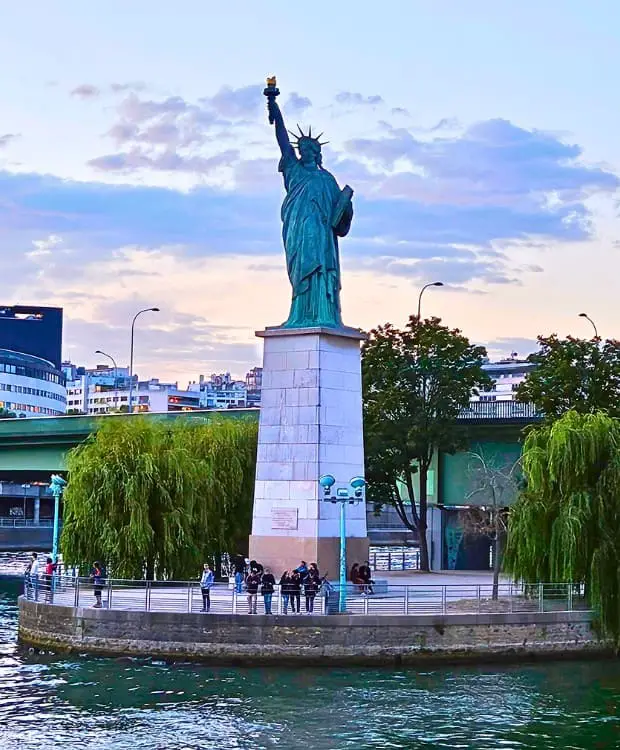
This is the big one, a full-size bronze copy standing on a narrow man-made island in the middle of the Seine. The American community living in Paris gave it to France in 1889, marking the 100th anniversary of the French Revolution.
At 38 feet (11.5 meters), it is the largest Statue of Liberty replica in the city, and one of the few outside the U.S. that visitors can walk right up to.
It originally faced east toward the Eiffel Tower. In 1937, it was turned around to face west, in the direction of the original in New York Harbor, roughly 3,600 miles (5,800 kilometers) away.
You can see it from the Pont de Grenelle, or from any Seine river cruise that passes under the bridge. Head to Pont de Grenelle to find it.
Pont de l’Alma
Voir cette publication sur Instagram
This one is not a statue at all. It is a full-size replica of the torch’s flame, cast in gold-leafed copper, sitting on a stone pillar next to the bridge.
The United States gave it to France in 1989, to mark the 100th anniversary of the original statue. It was meant as a simple thank-you gift between two allies.
Then in 1997, Princess Diana died in the tunnel directly beneath it, and the flame became an unofficial memorial to her almost overnight. Visitors still leave flowers, notes, and photos at its base decades later.
You will find it at the northern end of the Pont de l’Alma, right beside the bridge.
Musée d’Orsay
Voir cette publication sur Instagram
This is the original bronze model Bartholdi made before the full-size statue existed, once displayed outdoors in the Jardin du Luxembourg. It now stands at the museum’s main entrance, at Esplanade Valéry Giscard d’Estaing, 75007 Paris.
It is also the perfect starting point this fall. Starting September 15, 2026, the Musée d’Orsay is running a major exhibition on Bartholdi’s life and work, timed to the 250th anniversary of the U.S. Declaration of Independence. If your trip lands between September 2026 and January 2027, this is where to start.
Jardin du Luxembourg
Voir cette publication sur Instagram
This smaller bronze version was the first true study for the New York statue, and Bartholdi donated it to the garden himself. It stood outdoors here from 1906 to 2012, until damage to the torch’s flame forced its removal.
A replica now stands in its place. You will find it near the garden’s southeast entrance, at these coordinates.
Place Michel Debré
Voir cette publication sur Instagram
This is the one nobody spots on the first try. There is no standalone statue here, just a small copy of Lady Liberty tucked into the breastplate armor of a much larger statue called “Le Centaure.”
Look closely at the centaur’s chest the next time you pass through. Can you find her?
Voir cette publication sur Instagram
Find it at Place Michel Debré.
Musée des Arts et Métiers
Voir cette publication sur Instagram
This museum actually holds two. The first is Bartholdi’s original 1:16 scale plaster study, painted and displayed with details you cannot see on the full-size statue in New York.
Voir cette publication sur Instagram
The second is a bronze cast of that same plaster mold, on display in the museum from 2010 to 2021. On July 14, 2021, it left for the United States on a 10-year loan, a gesture of Franco-American friendship. It is due back in the museum in 2031.
Until then, the plaster original is still there, waiting at the end of your visit to the Musée des Arts et Métiers.
These six statues are all copies and studies. The original was never built in New York at all. Every copper sheet was hammered into shape inside a Paris workshop, years before the statue ever crossed the Atlantic. See how Paris built the Statue of Liberty, piece by piece, before it ever saw New York Harbor.

With a passion for travel and having visited over 50 countries, Dorian is eager to share his favorite spots and expert tips to help you explore Paris and France like a local.